

Artificial Intelligence at Work: Benefits, Risks, and Tools for Workforce Organizations

By Lesia Barnes, CJC IDHS Program Manager
Artificial intelligence is becoming part of conversations in every sector, including workforce development. For many organizations and non-profits, the question is not whether AI has a role in our work, but how to use it.
The good news is we do not have to start big.
Sometimes AI can support simple, practical tasks: brainstorming outreach ideas, rewriting correspondence, organizing information or helping staff think through questions in new ways. Used well, it can support efficiency and creativity, not replace human judgment and that distinction matters.
Workforce development is rooted in relationships, trust, and people-centered practice. Technology should support that work, not compete with it. What I have found encouraging is that many workforce providers are approaching AI with curiosity while also asking important questions about ethics, access, and equity. Those are the right questions.
If your organization is new to AI, start small. Look for ways it can reduce administrative burden or generate ideas. Pilot what works, then share what you learn with staff. Just as importantly, help job seekers understand how AI is shaping the workplace. Many industries are already changing, and digital readiness increasingly includes understanding emerging tools.
At the Chicago Jobs Council, conversations about innovation often come back to the same principle: tools matter most when they strengthen practice and expand opportunity.
AI may be one of those tools if we approach it thoughtfully, critically, and with people at the center. As organizations begin exploring AI, it can be helpful to consider both the opportunities and the challenges.

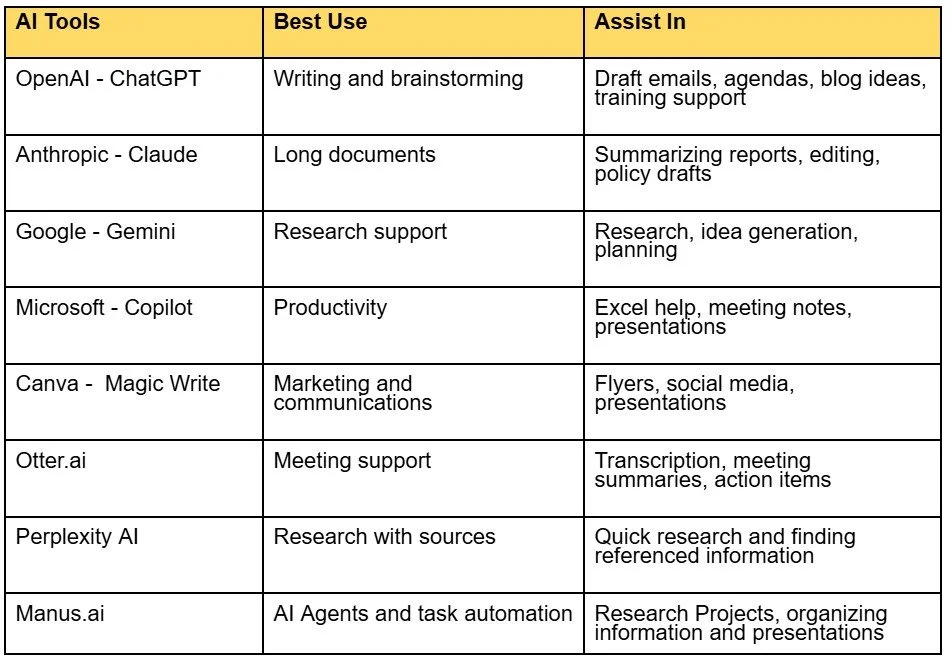
Many AI tools offer free versions or limited free use, which can make them more accessible for organizations wanting to explore AI before investing in paid upgrades. However, fees may apply for premium features, higher usage limits, advanced integrations, or additional storage.
AI will continue shaping how many organizations work and how industries evolve. Workforce organizations do not need to have every answer right away, but starting meaningful conversations now may help staff and job seekers prepare for what comes next. Sometimes innovation begins with one small step.
In March and April 2026, Chicago Jobs Council also hosted two AI-focused trainings designed to help participants strengthen their understanding of generative AI tools and how they can support career development services. These sessions introduced practical ways AI can be integrated into workforce development settings to enhance both staff efficiency and client outcomes. Topics included using tools such as ChatGPT, Perplexity, and Manus, the increasing adoption and evolution of AI, career exploration, resume and cover letter development, interview preparation, communication strategies, outreach, and strengthening professional writing skills. The trainings also explored how AI can support day-to-day workflow tasks while helping providers prepare clients to navigate an increasingly technology-driven workforce.
If your organization is exploring AI and looking for support, technical assistance, or opportunities for learning and discussion, please feel free to reach out to the Chicago Jobs Council Capacity Building Team at capacitybuilding@cjc.net.
Additional Reading/Resources:
National Skills Coalition – We Can’t Build an AI Economy Without an AI-Ready WorkforceJobs for the Future (JFF) – JFFLabs Artificial Intelligence
